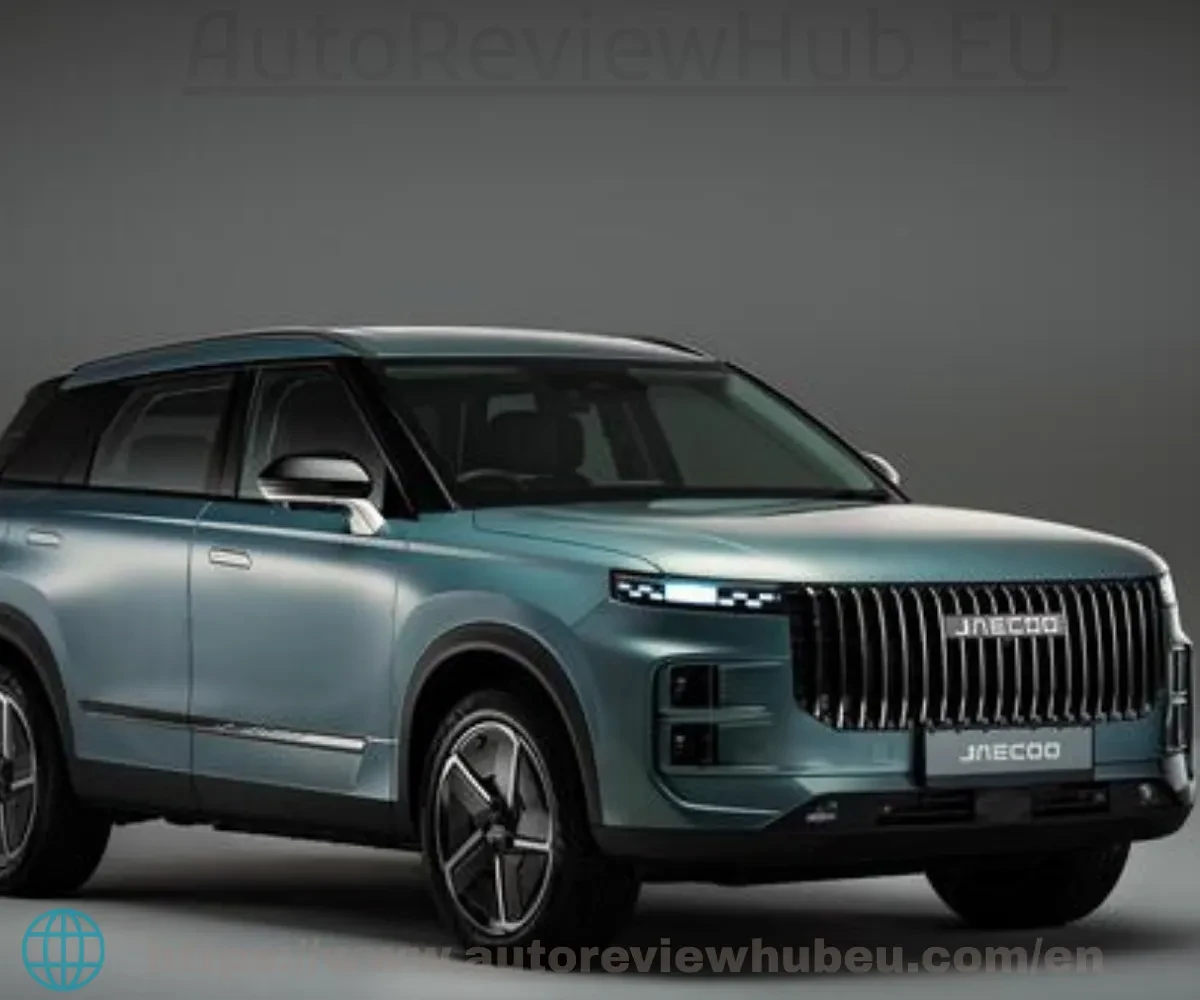
Jaecoo 7 EU review: PHEV electric range ~90 km class, 5-star Euro NCAP, from ~€33,990, vs Sportage/Tucson for FR/DE/ES buyers. 2026.
Compare · Editorial comparisons · Categories · Articles · Community Q&A · Sitemap · EU tariffs · JAECOO brand
Updated 3 August 2026 — 7 figures for European buyers (list price orientation, WLTP where published, charging/warranty notes) were re-checked. Confirm the live FR/DE/ES/IT/NL/BE configurator and workshop distance before you order. Who is the Jaecoo J7 actually for in Europe? The compact SUV segment is where European buyers are most spoiled for choice—Kia Sportage, Hyundai Tucson, Nissan Qashqai, Volkswagen Tiguan—all proven, all well-supported, all with years of residual value data behind them. The Jaecoo J7 walks into that fight from a standing start, carrying a Chinese badge most European drivers had never seen before 2024. What it brings to the table is hard to ignore: a five-star Euro NCAP rating, a seven-year warranty, a panoramic roof and 14.8-inch infotainment as standard, and a starting price from €33,990 that undercuts the Korean and European competition by a meaningful margin. What it cannot yet bring is a service history, a resale track record, or the kind of long-term ownership confidence that only comes with time in market. This page works through both sides of that equation honestly—spec by spec, driving impression by driving impression—so you can decide whether the J7's strengths match what you actually need from a family SUV in 2024 and 2025. What do owners say after real mileage? City driving In town the Jaecoo J7 is easy to place despite its 4.5-metre length. The steering is light, the 360-degree surround-view camera—standard on higher grades—handles tight parking confidently, and the automatic gearbox pulls away from lights without drama. The 1.6T petrol engine feels a little hesitant at very low throttle openings, a trait common to small turbocharged units in this class, but it is never uncomfortable once moving. The PHEV (SHS-P) variant is a different experience in the same conditions: in pure electric mode it is effectively silent at low speeds and responds instantly from rest, which makes a real difference in dense city traffic where the petrol's low-speed hesitation would otherwise be most noticeable. Motorway driving On the motorway the J7 settles into a composed, unhurried cruise. Wind and road noise are well managed at 110–130 km/h—reviewers across several European markets consistently describe the cabin as quieter than the entry price would suggest. The DCT holds high gears smoothly and the car feels planted, though overtaking above 120 km/h requires a deliberate press of the throttle: the 147 PS petrol is adequate for the task, not quick. Real-world fuel consumption at sustained motorway pace sits around 8.5–9.5 L/100 km, which is worth factoring in for anyone covering high annual mileage on the autoroute or Autobahn. The PHEV version, once its 18.3 kWh battery is depleted, continues to operate as a self-charging hybrid rather than a dead weight, and this meaningfully reduces consumption on long runs compared with the straight petrol variants. Mountain and hilly roads On winding or hilly routes the J7 manages gradient changes without strain. The AWD petrol variant adds a degree of confidence on damp or loose surfaces, and the 195 mm of ground clearance is genuinely practical for unpaved Alpine approach roads and rural tracks found across central and southern Europe. The DCT can feel slightly reluctant when kicking down for engine braking on steep descents—a characteristic shared with most dry dual-clutch gearboxes in this application and not specific to the J7. The available drive modes (Sport, Eco, Snow, Mud, Sand) extend the car's usable range, though it remains firmly a road-biased family SUV rather than a serious off-road tool. Road and wind noise Cabin refinement is one of the J7's most consistent strengths relative to its price. Wind noise is well suppressed up to legal European motorway speeds, and road surface intrusion through the structure is modest for the class. Tyre roar becomes more apparent on coarser asphalt—a trait shared with most SUVs running 19-inch rubber in this size range. Th