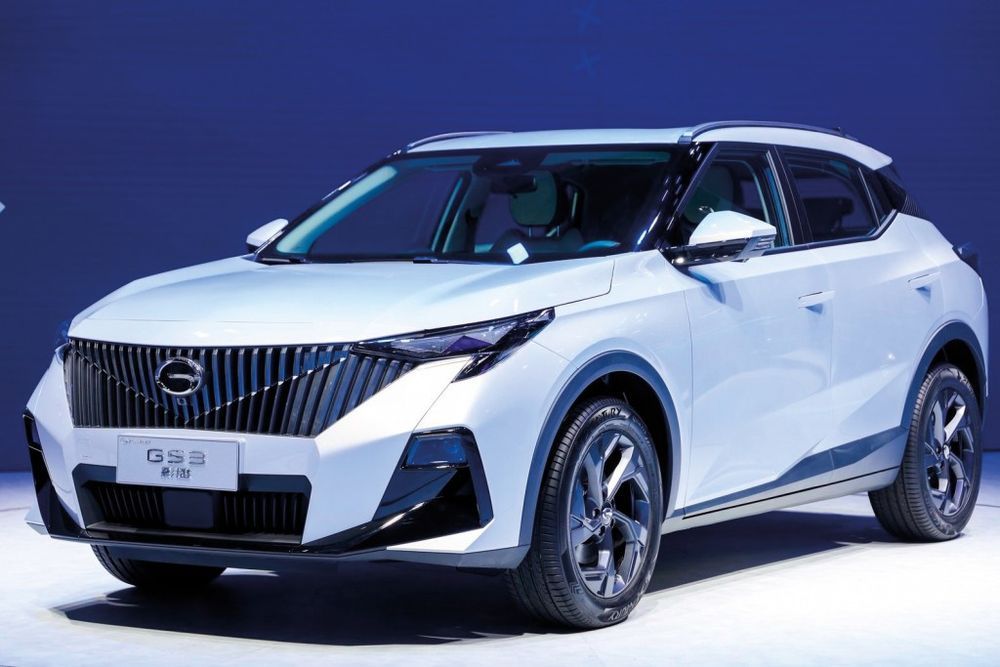
GAC GS3 EU review: list price from €14,000, compact SUV role vs Captur-class rivals, warranty caveats and who should shortlist it in France and Germany.
Compare · Editorial comparisons · Categories · Articles · Community Q&A · Sitemap · EU tariffs · GAC brand
Updated 3 August 2026 — GS3 figures for European buyers (list price orientation, WLTP where published, charging/warranty notes) were re-checked. Confirm the live FR/DE/ES/IT/NL/BE configurator and workshop distance before you order. For shoppers in France, Germany, Spain, Italy, Belgium or the Netherlands, the GS3 decision is rarely brochure-peak alone: it is list price after options, real public charging on your corridors, and whether a credible workshop sits within a sensible drive of home. Who is the GS3 actually for in EU driving? Market angle: If you’re evaluating Chinese metal for EU roads, context beats slogans. For the GAC GS3 2026, we emphasise motorway behaviour, ownership friction (service, parts), and whether the numbers fit your annual mileage. Key figures we’ll reference: a list price from €14,000 — always reconcile with your market and trim. Is the driving experience a strong point of the GAC GS3? Powertrain headline: 1.5L Turbocharged 4-Cylinder Engine, 170 HP . Road behaviour still depends on gearing, tyres, and EU-market tuning. The GAC GS3 tops out at 210 km/h, a respectable figure for motorway cruising. For petrol/diesel/hybrid buyers, motorway manners—noise, overtaking ease, stable fuel use—often outweigh brochure sprint times. Real EU driving: weather, routes, and urban life Cold-start behaviour and tyre choice affect fuel use and grip in winter; in hot summer touring, A/C load and cruise stability shape real-world comfort. In short: a proper test drive usually settles the debate. In dense European cities—tight parking bays and frequent low-speed manoeuvres—a compact footprint and clear sightlines reduce daily friction; that matters as much as brochure performance for many urban buyers. Price & Market Position in Europe How the GAC GS3 2026 is priced defines what it competes against in measured specs. Priced from €14,000 in Europe, the GAC GS3 2026 targets the highly competitive entry-level segment. Always confirm drive-away cost, warranty coverage, and service packages for your market. Local taxes and trim mix can materially change the effective value equation. How competitive is the GAC GS3 in the current EU segment? Owner reports vary by market and mileage, so long-term data should carry more weight than launch commentary: weigh long-ownership feedback (service, wear items) more than launch-week hype. These pages organise verifiable facts—not personalised purchase or investment advice. What do owners say after real mileage? This block comes from your human observations to avoid generic template-only wording. City driving The GAC GS3 2026 feels well-suited for urban environments thanks to its compact size and responsive low-speed behavior. Steering is light, making it easy to maneuver through traffic and tight parking spaces. The turbocharged 1.5L engine (in most trims) delivers adequate performance for daily commuting, with smooth acceleration in normal driving conditions. In stop-and-go traffic, the dual-clutch transmission is generally quick but may feel slightly hesitant at very low speeds depending on calibration. Overall, it is clearly designed for city practicality with a slightly sporty edge. Motorway driving On highways, the GS3 remains stable at moderate cruising speeds. The turbo engine provides enough power for steady driving, but overtaking at higher speeds requires planning. Cabin insulation is average, and wind noise becomes more noticeable above 110–120 km/h. While it can handle long-distance driving, it is more comfortable in short to medium highway trips rather than high-speed touring. Mountain / hilly roads On inclines and mountain roads, performance depends heavily on the engine version. The turbo variant performs noticeably better, offering sufficient torque for climbing. However, under full load, the engine can feel strained on steep gradients. The transmission downshifts quickly to maintain momentum, prioritizing efficiency and drivability rather than strong performance. Road and