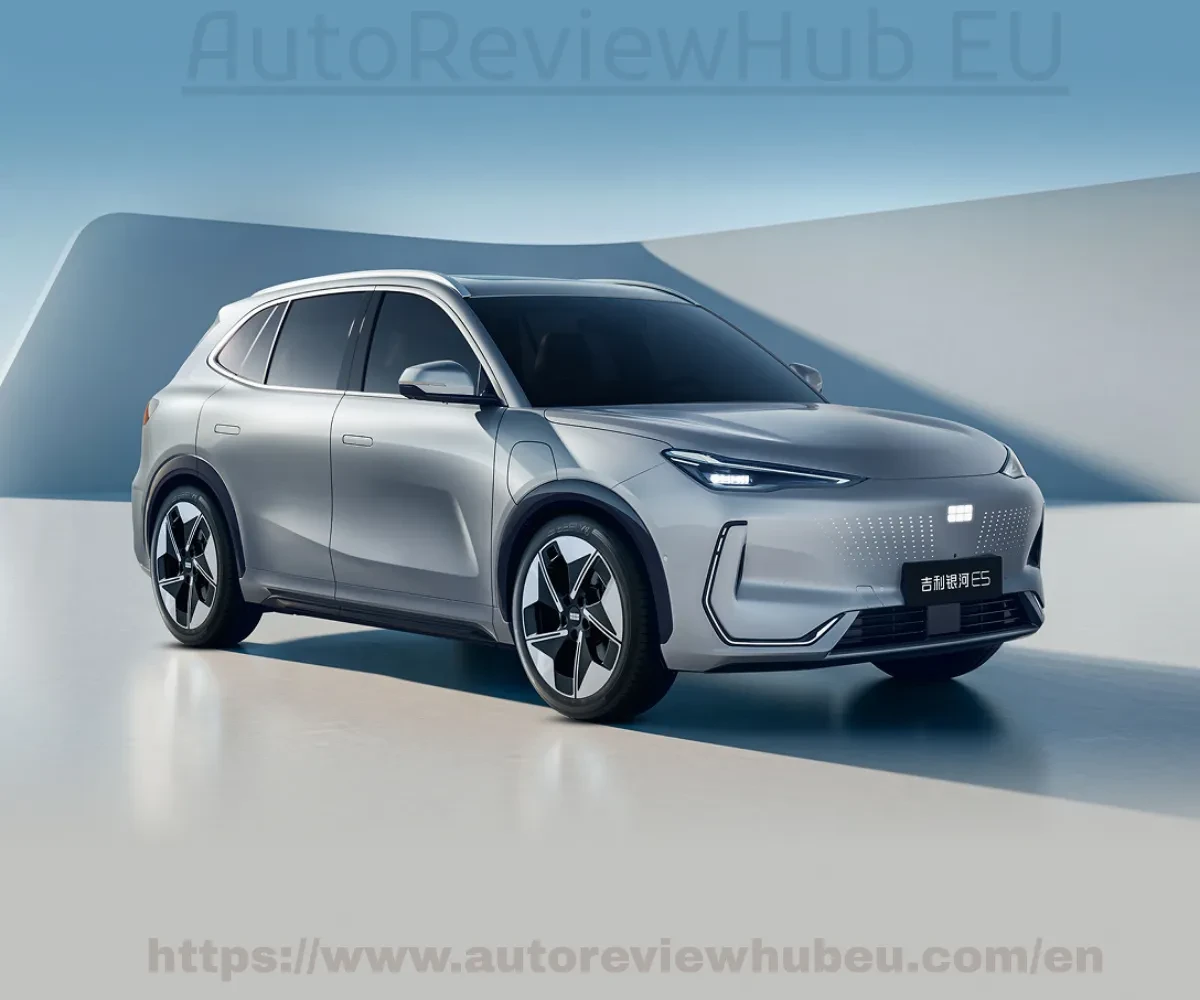
Geely E5 EU review: from €37,990, 475 km WLTP, DC charging notes, bonus eligibility caveats and vs Atto 3 / ID.4 for European shoppers. 2026.
Compare · Editorial comparisons · Categories · Articles · Community Q&A · Sitemap · EU tariffs · GEELY brand
Updated 3 August 2026 — E5 figures for European buyers (list price orientation, WLTP where published, charging/warranty notes) were re-checked. Confirm the live FR/DE/ES/IT/NL/BE configurator and workshop distance before you order. For shoppers in France, Germany, Spain, Italy, Belgium or the Netherlands, the E5 decision is rarely brochure-peak alone: it is list price after options, real public charging on your corridors, and whether a credible workshop sits within a sensible drive of home. Who is the E5 actually for in EU driving? Performance angle: If you’re evaluating Chinese metal for EU roads, context beats slogans. For the GEELY E5 2026, we emphasise motorway behaviour, ownership friction (service, parts), and whether the numbers fit your annual mileage. Key figures we’ll reference: a list price from €37,990; WLTP range quoted at 475 km — always reconcile with your market and trim. Does the GEELY E5 feel convincing in day-to-day EU driving? City driving The E5 is genuinely at home in urban traffic. The electric powertrain delivers smooth, immediate torque from standstill, and the low-speed ride is comfortable enough to absorb the worst of cobblestoned town centres. The 360-degree camera and tight turning circle make parking straightforward for a car of this size. In stop-and-go, the regenerative braking can be set to its highest level via the touchscreen — it holds speed reductions but does not bring the car to a full stop, so the driver always needs to apply the brake pedal. Noise isolation in EV mode is good. The ADAS suite is comprehensive but, as UK reviewers have noted, the alerts can be frequent and intrusive; expect to spend a few minutes disabling what you don't need at the start of each drive. Motorway driving On the autoroute, the E5 settles into a quiet, capable cruiser. Wind and road noise suppression is better than expected for this price bracket, and the adaptive cruise control handles lane-holding cleanly at sustained speed. At 130 km/h, real-world consumption is considerably higher than the WLTP figure — plan for roughly 18–22 kWh/100 km at sustained motorway pace with the 68.4 kWh battery, which translates to a practical motorway range of around 310–380 km between charges. The 160 kW DC charging capability means a 20-minute stop recovers sufficient range for most inter-city legs. This is not a car for 800 km days without planning, but for regular autoroute commutes it performs adequately. Mountain / hilly roads The firm suspension calibration — a mild criticism in urban use — actually works in the car's favour on winding mountain roads, reducing body roll and keeping the car reasonably composed through bends. The electric motor's instant torque handles steep gradients without complaint. Regenerative braking on descents assists speed control, though again without full one-pedal capability. Ground clearance of 170 mm is adequate for sealed Alpine passes but this is not a car designed for unpaved tracks. Road and wind noise Wind noise is well controlled for the class. Road noise from coarse surfaces intrudes more than on a Volkswagen ID.4 or Kia EV3, though it remains inoffensive in most conditions. The top-trim Max+'s audio system with headrest speakers does an effective job masking ambient noise on long runs. Gearbox feel Single-speed direct drive — no gear changes. Power delivery is smooth and linear in Eco and Comfort modes. In Sport mode, response sharpens noticeably but the car still doesn't feel particularly quick by EV standards; the 6.9-second 0–100 figure is real but the sensation is more of a purposeful surge than a punch. The steering column-mounted drive selector is well-placed and intuitive. Resale outlook No EU resale data is available as of May 2026 — the car is too new. UK residual value forecasts for the EX5 sit in the 47–49% range at three years, comparable to the BYD Seal U, and notably above the Ford Kuga PHEV at 42–43%. However, these are projections by finance houses, not measured mar